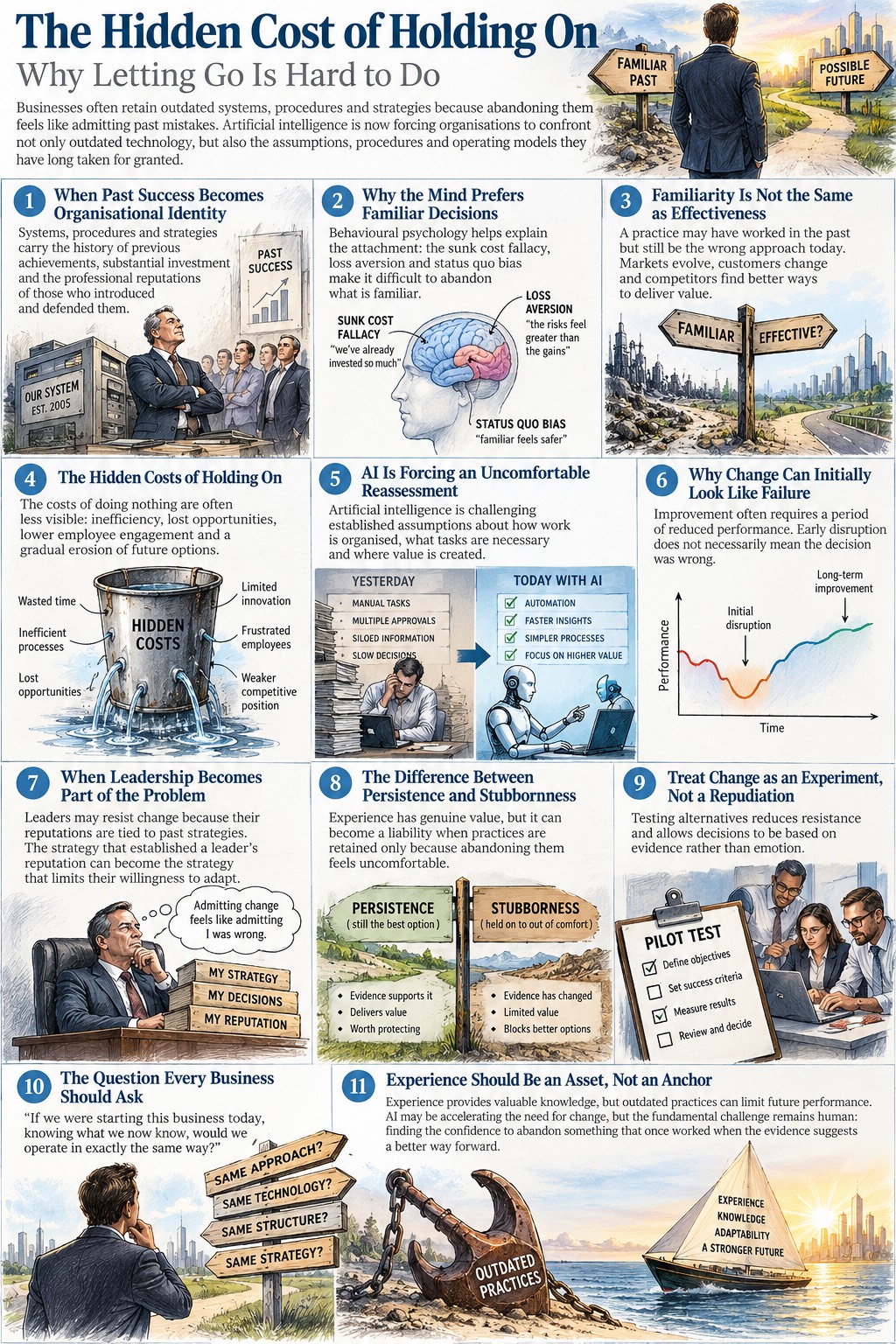
The Hidden Cost of Holding On
Why Letting Go Is Hard to Do
There is a curious contradiction in business. Experienced executives often recognise that established systems are becoming inefficient, familiar procedures are no longer delivering results and strategies that once provided a competitive advantage may have lost their effectiveness. Yet when someone proposes a different approach, resistance can be surprisingly strong.
The difficulty is not necessarily a lack of understanding. Established practices carry the history of previous achievements, substantial investment and the reputations of those who introduced them. Over time, successful strategies become embedded in organisational identity, while familiar procedures acquire the status of unquestioned truths.
Changing direction can therefore feel like admitting that previous decisions were wrong.
Artificial intelligence is making this tension increasingly difficult to ignore. By challenging traditional assumptions about how work is organised, how decisions are made and where value is created, AI is forcing businesses to reconsider practices they may have followed for decades.
The greatest obstacle to change may not be uncertainty about the future, but an unwillingness to reconsider the past.
When Experience Becomes an Obstacle
Consider a business that has relied on the same operating system for twenty years. It was originally introduced after careful evaluation, required considerable investment and helped deliver important improvements.
Employees became proficient in its operation, managers developed procedures around it and executives came to regard it as essential to the organisation’s success.
Eventually, newer technologies offer greater flexibility, improved integration and lower costs. Yet replacing the system encounters resistance.
Those who introduced it may interpret criticism as questioning their judgement. Employees worry that their expertise will become less valuable, while managers prefer familiar limitations to uncertain alternatives.
The organisation is no longer evaluating only the merits of competing systems. It is protecting the history and professional identities associated with the existing one.
Behavioural psychology helps explain this attachment. The sunk cost fallacy encourages continued investment because substantial resources have already been committed. Loss aversion makes the immediate risks of change feel more significant than its potential benefits, while status quo bias encourages people to regard familiar arrangements as inherently safer.
The result is a dangerous confusion between familiarity and effectiveness.
A procedure that worked successfully for twenty years may have been entirely appropriate when introduced. That does not establish that it remains the best approach today.
AI Is Exposing the Weaknesses in Established Practices
Artificial intelligence is accelerating this reassessment.
For decades, businesses have designed operating structures around the limitations of available technology. Entire departments, reporting systems and approval procedures evolved because information was difficult to assemble, decisions required extensive coordination and many administrative tasks demanded considerable human effort.
AI is challenging those assumptions.
A professional services firm that traditionally charges for time spent researching and preparing information may need to reconsider its pricing model when AI reduces the effort required for some activities.
A company with multiple layers of management approval may discover that improved access to information reduces the need for certain reporting and coordination processes.
A business employing large teams to perform repetitive administrative work may find that its greatest opportunity lies not in automating individual tasks, but in redesigning the way work is organised.
The important question is no longer simply whether AI can make an existing process faster. It is whether that process should continue to exist in its present form.
There is a danger that organisations will embrace AI while preserving the very inefficiencies it could help eliminate.
Producing unnecessary reports more quickly does not make those reports valuable. Automating an elaborate approval process does not establish that the approvals are necessary. Introducing AI into customer service will achieve little if outdated policies remain the underlying cause of customer frustration.
Technology can make an inefficient organisation faster without making it fundamentally better.
AI also brings genuine risks involving accuracy, security, privacy and accountability. Not every activity should be automated, and established safeguards may remain essential.
The challenge is to distinguish practices that continue to create value from those that survive simply because they are familiar.
The Hidden Cost of Doing Nothing
Businesses generally understand the visible costs of change. New systems require investment, employees need training and implementation can temporarily disrupt performance.
The costs of maintaining outdated practices are less obvious.
An inefficient process may waste only a few minutes each day. An unnecessary approval may delay a decision by several hours. An ageing system may require occasional modifications to remain operational.
Individually, these disadvantages appear manageable. Collectively, they can become a substantial burden.
More importantly, resources devoted to preserving existing arrangements cannot be invested in developing new capabilities.
The organisation may remain profitable while its ability to compete and adapt gradually deteriorates.
This is why the distinction between persistence and stubbornness matters.
Persistence is justified when evidence continues to support an established approach. Stubbornness emerges when an organisation maintains that approach despite credible evidence that circumstances have changed.
The objective should not be change for its own sake. Established practices often embody valuable experience, operational safeguards and customer knowledge that should not be discarded lightly.
But neither should they be preserved simply to protect earlier decisions.
Changing Direction Is Not Admitting Failure
One of the most effective ways to overcome resistance is to treat change as an experiment rather than a repudiation of the past.
Instead of declaring that an existing system has failed, management can test whether an alternative produces better outcomes under current conditions.
Limited trials, measurable performance criteria and clear review points allow organisations to assess new approaches without immediately abandoning established capabilities.
This also recognises an important distinction.
A decision that was correct twenty years ago does not become a mistake because a better alternative exists today.
Markets change, technology advances and customer expectations evolve. Sound management requires decisions to change accordingly.
The same principle applies to leadership. Executives should be judged not simply by their consistency in defending earlier strategies, but by their willingness to adapt those strategies when new evidence emerges.
The strategy that established a leader’s reputation should not become the strategy that prevents the organisation from progressing.
The Question Every Business Should Ask
Perhaps the most revealing question for an established organisation is also one of the simplest:
“If we were starting this business today, knowing what we now know, would we choose to operate in exactly the same way?”
Would we purchase the same technology, establish the same management structure and introduce the same approval procedures?
Would we organise work around the same assumptions about information, labour and decision-making?
And knowing what AI can now make possible, would we still design the business in its present form?
The answer may sometimes be yes. Some established practices continue to offer substantial advantages.
But where the answer is no, management has identified something worth examining.
The question encourages businesses to evaluate practices according to their future value rather than the investment and emotional attachment associated with their history.
Experience Should Be an Asset, Not an Anchor
One of the greatest strengths of an established business is its accumulated experience. Years of operating knowledge, customer relationships and institutional learning can provide advantages that newer competitors struggle to replicate.
But valuable experience is not the same as preserving every practice that experience has produced.
Experience should help organisations recognise what works, understand why it works and identify when circumstances have changed. Outdated practices, by contrast, can cause businesses to repeat yesterday’s decisions long after the conditions that justified them have disappeared.
Artificial intelligence is bringing this distinction into sharper focus. The businesses that benefit most may not be those that adopt AI most aggressively, but those willing to question their assumptions about how value is created.
They will preserve the knowledge that continues to matter while reconsidering procedures, systems and strategies that no longer serve their purpose.
Ultimately, the greatest cost of holding on is not simply the money spent maintaining yesterday’s systems.
It is the opportunity lost when a business becomes so committed to proving its previous decisions were right that it stops asking whether better decisions are now available.
AI may be accelerating the need for change, but the fundamental challenge remains human: finding the confidence to abandon something that once worked when the evidence suggests a better way forward.
The real measure of business experience is not how successfully an organisation defends the past, but how intelligently it distinguishes what should be carried forward from what should be left behind.