
Brute Force Versus Elegance: Two Approaches to Artificial Intelligence
Why America’s pursuit of computational power and China’s emphasis on efficiency offer different lessons about technological innovation.
There is an interesting contrast emerging in the development of artificial intelligence. The United States has largely pursued technological leadership by assembling enormous computing resources, vast quantities of data and billions of dollars in investment. China, facing restrictions on access to advanced semiconductors, has placed greater emphasis on finding ways to achieve comparable results with fewer resources.
The distinction brings to mind two familiar approaches to solving problems. One is to throw enough technology at a problem in the expectation that something will eventually work. The other is to think more carefully about the problem and find a simpler, more elegant solution.
Neither approach is exclusively American or Chinese, but the contrast offers an interesting perspective on the AI revolution.
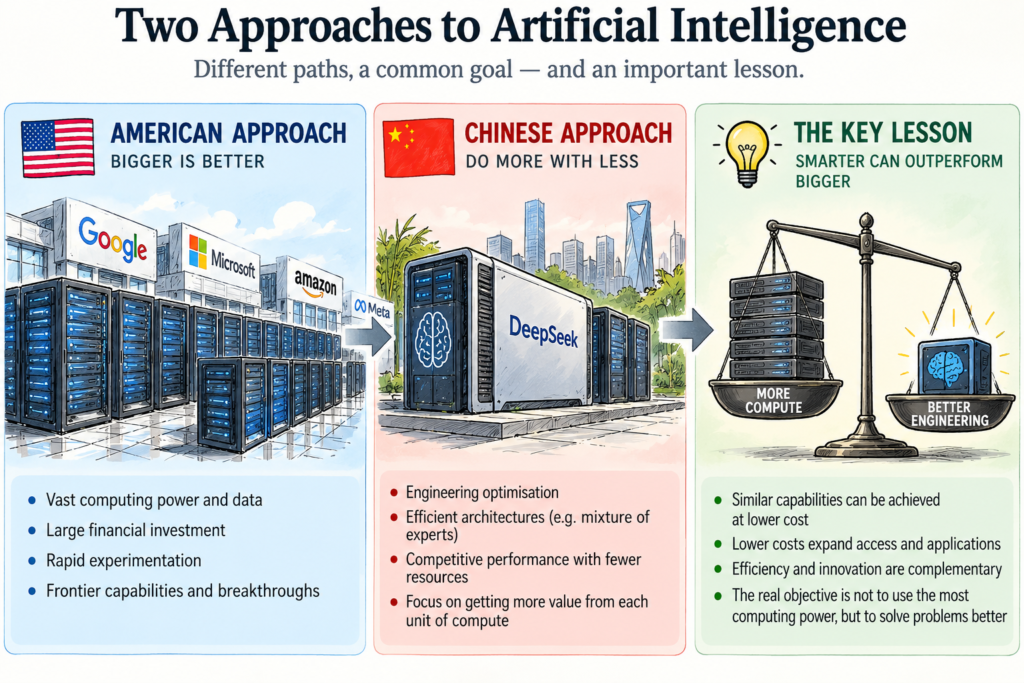
The American Approach: Bigger Is Better
Much of the extraordinary progress in large language models has come from a relatively straightforward discovery: increasing the amount of data, computing power and model capacity can substantially improve performance.
The Transformer architecture, introduced by Google researchers in 2017, made it possible to train increasingly sophisticated models using enormous computing systems.
American technology companies were particularly well positioned to exploit this discovery. They possessed the capital, semiconductor technology, cloud infrastructure and research talent needed to experiment on an unprecedented scale.
The results have been remarkable. Models originally designed to predict the next word or fragment of text have developed capabilities in language, mathematics, programming and complex problem-solving.
The American approach has an important advantage. Large-scale experimentation can produce discoveries that would be difficult to anticipate through careful planning alone. Failure is tolerated because occasional breakthroughs can justify enormous investments.
But there is a potential weakness. When resources are plentiful, it is tempting to solve problems by adding more computing power rather than questioning whether the underlying system could be made more efficient.
At some point, the additional benefit from ever-greater expenditure may no longer justify its cost.
The Chinese Approach: Doing More With Less
China faces a different set of circumstances.
American restrictions on access to advanced AI semiconductors have encouraged Chinese researchers to pay particular attention to computational efficiency.
DeepSeek is perhaps the most prominent example. Its models have demonstrated that competitive AI performance can be achieved through intelligent architectural choices and careful optimisation, potentially using substantially fewer computational resources for particular tasks.
One technique, known as mixture of experts, allows a model to activate only the parts of its neural network needed for a particular calculation rather than using the entire system every time.
Other techniques reduce memory requirements, improve training efficiency and transfer capabilities from larger models into smaller ones.
Many of these innovations originated in international research, including American laboratories. China’s achievement lies partly in combining and refining them under demanding resource constraints.
The underlying philosophy is different. Instead of asking how much computing power can be assembled, the question becomes how much useful intelligence can be extracted from each unit of computing power.
There is an old engineering principle at work here: constraints can encourage ingenuity.
That does not mean Chinese AI development is inexpensive or that China has abandoned large-scale investment. Nor does it establish that Chinese models universally match the most capable American systems. Nevertheless, it challenges the assumption that technological progress must always depend on ever-increasing expenditure.
An Echo of the Cold War
The contrast recalls the competition between American and Soviet computing during the Cold War.
IBM’s System/360, introduced in 1964, established a commercially successful computing architecture supported by substantial research investment and a growing software ecosystem.
The Soviet Union initially developed several original computer designs but later adopted a strategy of building IBM-compatible systems. Rather than independently developing every component of a new computing architecture, Soviet engineers sought to reproduce and adapt an established one.
This saved development effort but came at a price. Dependence on an architecture developed elsewhere contributed to a persistent technological lag.
The comparison is imperfect. Soviet computing was not simply an example of elegant engineering, nor is modern Chinese AI merely an exercise in copying Western technology.
Indeed, the Soviet experience illustrates the danger of confusing resourcefulness with innovation. Adapting an existing technology can be economical, but long-term leadership requires the ability to develop new ideas rather than simply improve someone else’s.
The broader historical lesson is that technological success depends on finding the right balance between invention, adaptation and efficient execution.
The Economics of Intelligence
Perhaps the most important consequence of this competition is not which country develops the most powerful AI model, but how cheaply useful intelligence can be delivered.
Imagine that one AI system requires $100 million in computing resources to perform a particular range of tasks, while another achieves comparable results for $10 million.
The second system may not be more intelligent, but it is potentially far more valuable economically.
Reducing the cost of AI makes sophisticated capabilities accessible to smaller businesses, encourages new applications and expands the market for services that would previously have been uneconomic.
There is an interesting paradox here. Making AI cheaper may actually increase total demand for computing power as more organisations discover profitable uses for it.
This is a version of the Jevons paradox: improvements in efficiency can increase overall consumption rather than reduce it.
Consequently, the future of AI is unlikely to be determined by computational scale or efficiency alone. The most successful systems may combine the advantages of both.
The Lesson for Australia
For Australia, the implications are particularly relevant.
We are unlikely to compete with the United States or China by investing comparable amounts in enormous data centres and frontier AI models.
Nor do we necessarily need to.
Australia’s opportunity lies in applying increasingly affordable AI to industries where we possess distinctive expertise, valuable information and established commercial capabilities.
That requires a different mindset from simply purchasing the latest technology.
Businesses frequently assume that investing in new software or more powerful computing systems will automatically improve productivity. Yet the greater opportunity often lies in reconsidering the processes those systems are intended to support.
Automating an inefficient business practice may simply allow an organisation to perform the wrong activity more quickly.
The more valuable question is whether the activity needs to be performed in the first place, or whether AI makes an entirely different approach possible.
This is where the Chinese emphasis on efficiency offers a useful lesson, regardless of its geopolitical origins. Understanding the problem more deeply can sometimes deliver greater benefits than committing more resources to an existing solution.

Intelligence Is Not Measured by Expenditure
The American approach to AI has demonstrated the extraordinary discoveries that become possible when enormous resources are concentrated on a technological challenge.
China’s emphasis on efficiency has demonstrated that progress can also come from questioning how those resources are used.
Both approaches have strengths, and both have limitations.
But the distinction points to something more fundamental about technological progress.
We tend to measure innovation by the size of the investment, the sophistication of the machinery or the scale of the infrastructure. These are readily observable and easily compared.
What is harder to measure is the quality of the thinking behind the solution.
As artificial intelligence becomes more powerful and more accessible, that distinction may become increasingly important.
The ultimate objective is not to build the biggest machine or consume the most computing power. It is to solve problems better, more economically and with greater understanding.
Sometimes the smartest solution is not to throw more technology at the wall, but to work out why the wall is there in the first place.