
Why Is Commercialising Science Getting Tougher?
Six growing pressures are making the journey from scientific discovery to commercial success more complicated, contentious and uncertain.
Our recent column, “Tough Gig, This Commercialisation!”, prompted a considerable number of comments and questions. While readers approached the subject from different perspectives — scientists, research institutions, commercial interests and the broader public — one question kept recurring:
Why? Why is commercialising science becoming so much tougher?
It is a fair question, and one that deserves more than a simple answer.
After all, scientific discovery has never offered greater commercial possibilities. Advances in biotechnology, medicine, computing and artificial intelligence are opening opportunities that would have been unimaginable a generation ago.
Surely, with more sophisticated technology, greater access to knowledge and growing demand for innovation, commercialisation should be getting easier?
Paradoxically, the opposite appears to be happening.
The difficulty is not that scientific discoveries have become less valuable. It is that the relationships between those who discover, fund, own, develop and ultimately benefit from them have become considerably more complicated.
The scientist claims intellectual authorship. The institution claims ownership. The government expects public benefit. The investor demands commercial returns. And artificial intelligence is introducing entirely new questions about who actually creates an invention.
Each may have a legitimate interest. But those interests do not necessarily coincide.
Looking more closely at the responses to our earlier column, and the underlying issues it raised, six interconnected pressures help explain why this already tough gig is getting tougher.
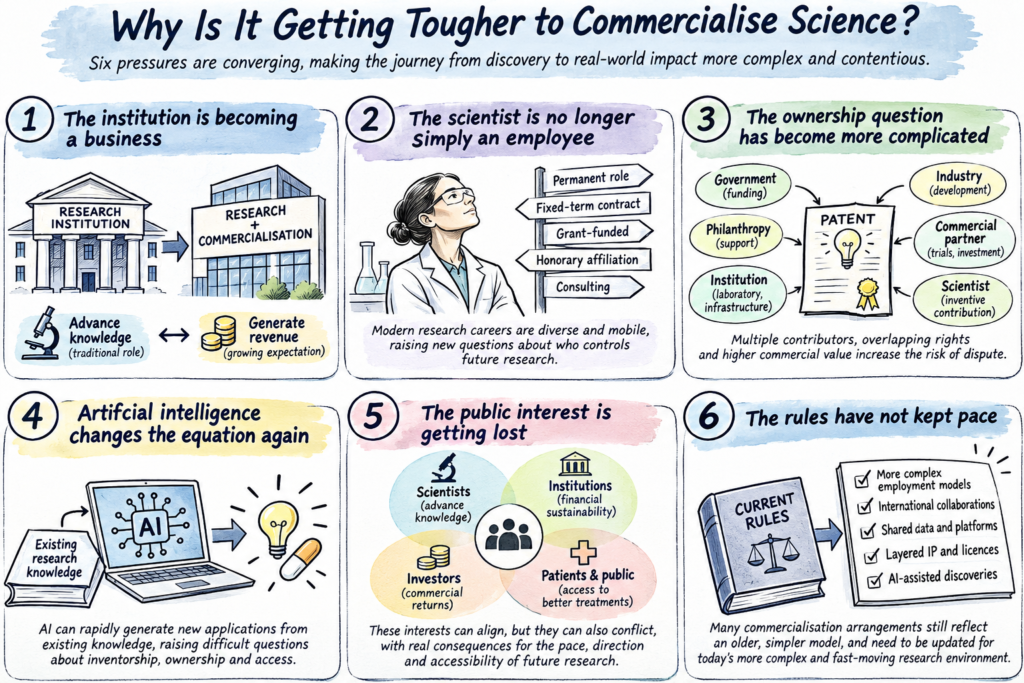
1. The institution is becoming a business
Research institutions were established to advance knowledge, not necessarily to generate commercial profits.
Yet financial pressures increasingly require them to operate like businesses, seeking income from patents, licences, industry partnerships and start-up companies.
Commercialisation is no longer simply an opportunity to translate research into public benefit. For some institutions, it is becoming an important part of financial survival.
That creates an inherent tension between protecting intellectual property as a commercial asset and supporting the open scientific inquiry that produced it.
2. The scientist is no longer simply an employee
Scientific careers increasingly involve fixed-term contracts, grant-funded appointments, honorary affiliations, consulting arrangements and movement between institutions.
A scientist’s research may continue for decades, while the contractual relationships governing ownership of resulting inventions change repeatedly.
The institution may own the patent, but the scientist retains the accumulated expertise, intellectual insights and professional relationships that made the discovery possible.
When the relationship ends, difficult questions arise about who can continue the research and on what terms.
3. The ownership question has become more complicated
Modern scientific discoveries rarely result from the efforts or funding of a single party.
Governments, institutions, philanthropic donors, scientists and commercial partners may all contribute to the same research program.
But funding, inventorship, ownership and commercial exploitation are legally and commercially distinct interests.
The more contributors involved, the greater the potential for overlapping rights, conflicting expectations and disputes — particularly when a discovery becomes commercially valuable.
4. Artificial intelligence changes the equation again
AI can generate new applications from existing scientific knowledge at extraordinary speed.
A discovery made decades ago may become the foundation for an AI-assisted invention that its original researchers never contemplated.
Who should own that invention? The original scientist, the institution holding the earlier patent, the AI developer or the researchers responsible for the new inventive contribution?
Existing intellectual property arrangements do not always anticipate these circumstances.
AI is therefore accelerating innovation while simultaneously complicating the allocation of commercial rights.
5. The public interest risks getting lost
Scientists seek to advance knowledge. Institutions require financial sustainability. Investors expect returns. Patients and the public want access to the benefits of research.
These objectives can reinforce one another, but they can also conflict.
A patent may encourage the investment necessary to develop a treatment, while overly restrictive licensing or disputes over access to research materials may impede further investigation.
The danger is that arguments over ownership and commercial control begin to overshadow the purpose for which the research was undertaken.
6. The rules have not kept pace
Many commercialisation policies and agreements still reflect a simpler model in which an institution employs a scientist, owns the invention and licenses it to industry.
Today’s research environment is far more complex.
International collaborations, shared datasets, overlapping intellectual property rights, changing employment arrangements and AI-assisted discoveries demand more sophisticated agreements.
Without clearer rules distinguishing foundational knowledge, new inventions, commercial rights and future research access, disagreements become increasingly difficult and expensive to resolve.
The underlying problem
These six pressures are not operating independently. They reinforce one another.
Financially stressed institutions become more protective of intellectual property. Scientists working under increasingly complex arrangements become more concerned about their rights. Commercial investors seek stronger protection for their investment. AI creates new opportunities that existing agreements may not anticipate.
And throughout this process, the public interest in advancing scientific knowledge risks becoming secondary to arguments about who owns what.
The answer is not to abandon commercialisation, nor to assume that scientists, institutions or investors should automatically prevail.
It is to develop arrangements that better align their interests, reward genuine contributions and preserve the capacity for future discovery.
The central question should not simply be who owns the science, but how ownership can best serve its advancement and practical application.
That is the challenge confronting research institutions, scientists, governments and industry alike.
And it explains why our earlier column ended as it did.
Tough gig, this commercialisation.
And getting tougher.