
Tough Gig, This Commercialisation!
When science becomes an asset, who owns the discovery, who deserves the rewards, and who decides what happens next?
The trouble with commercialising science is that science was never designed to be a business. Discovery is uncertain, success unpredictable, and some of the most valuable breakthroughs emerge from research undertaken without any commercial objective in mind.
Yet increasingly, our great research institutions are expected to behave like venture capital firms, pharmaceutical companies and intellectual property investment houses. They must discover, protect, patent, license and monetise their research while somehow preserving the curiosity, independence and intellectual freedom on which scientific progress depends.
Tough gig, this commercialisation!
The recent Sydney Morning Herald investigation into Melbourne’s distinguished Florey Institute of Neuroscience and Mental Health illustrates just how difficult, and potentially damaging, the collision between scientific discovery and commercial imperatives can become.
The investigation describes bitter disputes involving intellectual property, patent ownership, royalties, employment arrangements and the departures of internationally respected scientists. The Florey disputes claims about its financial and organisational circumstances, while allegations in individual proceedings remain contested.
Whatever the eventual outcomes, the underlying issues extend well beyond one institution. They expose a growing tension at the heart of Australia’s research sector: how to reconcile the rights of scientists, the legitimate interests of institutions, the expectations of those who fund research and the commercial opportunities that emerge from scientific discovery.
At its simplest, the question is: who should own the fruits of scientific discovery, and on what terms?
The scientist, the institution and the invention
The traditional starting point for intellectual property ownership appears relatively straightforward. Where an employee is engaged to invent or develop something in the course of their employment, the resulting intellectual property will commonly belong to the employer, subject to the employment contract, applicable law and the circumstances of the invention.
The familiar commercial proposition is that the employer pays and the employer owns. But scientific research rarely fits comfortably into such a neat arrangement.
Who, after all, is actually paying? Is it the institution providing the laboratory, the government supplying the research grant, the philanthropic donor supporting the project, or the commercial partner contributing equipment and development funding? And where does that leave the scientist who brings decades of accumulated knowledge, intellectual creativity, professional reputation and research relationships to the endeavour?
The position becomes more complicated when researchers operate under successive fixed-term appointments, honorary affiliations, grant-funded arrangements or contracts for services rather than conventional employment agreements. A contract for services is not necessarily a contract of employment, and paying for research does not automatically confer ownership of every invention that emerges from it.
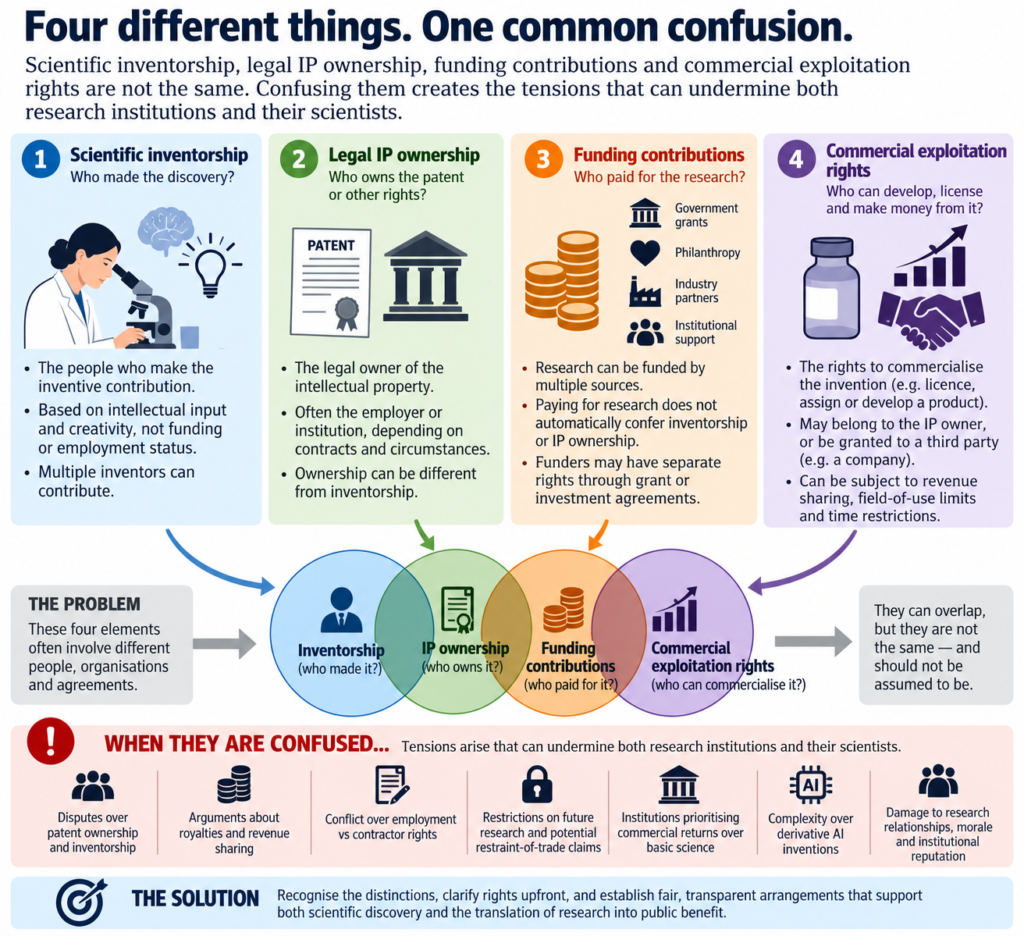
Under Australian patent law, ownership depends on factors including inventorship, employment obligations, contractual arrangements and valid assignments. Inventorship is not simply a reward for providing funding, supervising a laboratory or occupying a senior institutional position. It reflects the actual inventive contribution.
Consequently, an institution may own a patent without being the inventor, while a scientist may be recognised as an inventor without owning the patent. A research funder may have financed the entire project without acquiring either status.
These distinctions are far from academic. They determine who can license a discovery, establish a commercial venture, receive royalties and, in some circumstances, control access to technology essential for continuing research.
Having served as Head of Commercialisation at Midwest Research Institute, a top 10 US research institute, and at ANSTO, as well as being a founding member of the Licensing Executives Society, I’ve seen firsthand the challenges of balancing the interests of scientists, research institutions and commercial partners. These experiences have reinforced how easily the distinctions between inventorship, ownership, funding and commercial rights can become blurred — often to the detriment of the science itself.
When the contract ends, does the science end too?
Consider a scientist who has spent 20 years investigating a particular biological mechanism. Their expertise is inseparable from the research, their experimental techniques may have been refined over decades, and their scientific insights and professional relationships cannot simply be handed back with the laboratory keys.
Yet the patents, research materials, datasets and commercial opportunities associated with that work may be controlled by the institution.
When the relationship breaks down, difficult questions arise. Can the institution prevent the scientist from continuing the research elsewhere? Can it withhold access to essential materials or patented techniques? Can the scientist establish a company to pursue a new application of the discovery? What rights and obligations survive the termination of an employment or commercial agreement?
There is no universal answer. Much depends on the contracts, the nature of the intellectual property and the applicable legal obligations. Nevertheless, an important distinction exists between protecting an institution’s legitimate commercial interests and attempting to control a scientist’s future intellectual activity.
A patent does not confer general ownership over an entire field of scientific inquiry, nor does an employment agreement ordinarily entitle an institution to everything a researcher might subsequently think, discover or develop.
Restraint-of-trade principles may also become relevant where contractual restrictions extend beyond what is reasonably necessary to protect legitimate interests. Australian law recognises that restraints can be enforceable in appropriate circumstances, but unreasonable restrictions on a person’s ability to work or pursue their profession are generally viewed with caution.
Beyond these legal considerations lies a broader public interest. Should a dispute over ownership of yesterday’s invention be allowed to obstruct tomorrow’s discovery?
That question becomes especially uncomfortable when the research concerns Alzheimer’s disease, motor neurone disease or other conditions for which patients and families are desperately awaiting better treatments.
Basic science is not a failed commercial product
One of the more troubling developments in contemporary research management is the growing tendency to measure scientific success through commercialisation metrics: patents filed, licences executed, start-ups established, industry contracts signed and revenue generated.
These are legitimate measures of commercial activity, but they are not necessarily measures of scientific excellence or long-term public value.
Some of humanity’s most consequential advances have emerged from curiosity-driven research with no foreseeable commercial application. Indeed, the eventual commercial value of fundamental discoveries is often impossible to predict when the original work is undertaken.
Howard Florey’s association with the development of penicillin provides an especially appropriate reminder of the complex relationship between scientific discovery, public benefit and commercial development. The transformation of penicillin into a widely available medicine required contributions from scientists, institutions, governments and industry. Its extraordinary impact did not arise from a simple strategy of maximising institutional patent revenue.
Yet research institutions today face financial pressures that increasingly encourage them to prioritise projects with identifiable commercial prospects over fundamental inquiry.
The Florey reporting highlights a structural problem confronting much of the sector. Competitive research grants frequently fail to cover the full economic cost of conducting research, leaving institutions dependent on philanthropy, investment income, industry partnerships and commercial revenue to bridge the gap.
Commercialisation is therefore no longer merely an opportunity to translate discoveries into practical benefits. For some institutions, it has become an essential element of financial survival.
That inevitably influences behaviour. Research portfolios are assessed for their potential returns, intellectual property is treated as a financial asset, scientists are increasingly expected to generate commercial opportunities, and institutions may become more assertive in protecting or claiming ownership rights.
None of this is inherently unreasonable. Institutions must remain financially viable, and successful commercialisation can deliver enormous public benefits. The danger arises when the pursuit of intellectual property ownership becomes confused with the creation of scientific value.
An institution can accumulate patents without generating meaningful innovation, just as a scientist can make an extraordinary contribution to knowledge without producing an immediately marketable invention.
The two achievements should not be confused.
Protect the application, not the foundations of knowledge
A more sustainable approach requires a clear distinction between fundamental scientific knowledge and specific commercially exploitable inventions.
Discovering how a biological pathway operates is not the same as developing a diagnostic test, therapeutic compound or engineered device based on that understanding. Patent law already recognises distinctions between discoveries as such and patentable inventions, although the boundaries can be technically and legally complex.
The underlying policy objective should nevertheless be clear: fundamental scientific knowledge ought to remain as accessible as possible for further research, testing, replication and development, while genuinely inventive commercial applications should be capable of protection.
The difficulty arises when the boundaries between these interests become blurred.
Australia provides statutory exemptions for certain experimental activities relating to patented inventions, but those protections are not universal. They do not necessarily override contractual restrictions, confidentiality obligations or proprietary rights in research materials and datasets.
Research institutions therefore have an important role in designing arrangements that protect legitimate commercial interests without unnecessarily restricting scientific progress.
Research-use licences, clearly defined access rights, transparent material-transfer agreements and provisions preserving reasonable opportunities for scientists to continue non-commercial research can all reduce the risk of disputes becoming barriers to discovery.
This is not an argument against patents or commercial exclusivity. Both can be essential to attracting the investment required to transform promising research into practical products. Rather, it is an argument for ensuring that the scope of commercial protection is proportionate to the invention and does not unnecessarily enclose the underlying scientific knowledge.
The objective should be to protect the commercial application without compromising the foundations on which future discoveries depend.
The AI complication: who owns the derivative discovery?
If intellectual property ownership in scientific research is already complicated, artificial intelligence promises to make it considerably more so.
Imagine a scientist who spends 20 years discovering and characterising a biological mechanism. The institution owns patents covering particular applications, while a pharmaceutical company licenses some of the technology for further development.
An AI developer subsequently trains a model using published research, licensed datasets and other biological information. The model helps identify a new therapeutic application that neither the original scientist nor the institution had contemplated.
Who owns the resulting invention?
Is it the scientist whose work established the underlying mechanism, the institution holding the original patents, the pharmaceutical company funding subsequent development, the AI developer, or the researchers who conceived and validated the new application with AI assistance?
The answer may involve several overlapping rights, none of which necessarily belongs to the same party.
Patent rights, copyright, confidentiality obligations, contractual restrictions, trade secrets and rights governing access to research data may all become relevant. A new AI-assisted invention may be independently patentable while still requiring a licence to practise an earlier patented technology. Alternatively, it may fall entirely outside the scope of the original patent.
Australian patent law also requires human inventorship. The Federal Court’s appellate decision in Commissioner of Patents v Thaler established that an AI system cannot itself be named as an inventor under the existing legislative framework, although questions remain about how inventorship should be determined when AI makes increasingly substantial contributions to the inventive process.
The commercial implications are equally challenging.
The traditional argument that whoever pays for development should own the resulting intellectual property becomes less convincing when that development relies on generations of publicly funded scientific knowledge.
Yet the opposite approach, granting every original contributor an enduring proprietary interest in downstream applications, could make innovation prohibitively complicated.
AI will increasingly expose the inadequacy of arrangements that fail to distinguish between foundational knowledge, subsequent inventive contributions and the commercial rights required to bring new applications to market.
The challenge will be to reward genuine innovation without creating an endless chain of ownership claims over the scientific knowledge on which innovation depends.
User pays, user owns — but which user?
There is a compelling commercial argument that those who bear the financial risks of developing an invention should receive an appropriate share of the rewards.
Without the prospect of meaningful commercial protection, private investors may be reluctant to fund the expensive and uncertain process of transforming scientific discoveries into marketable products.
Drug development provides an obvious example. Clinical trials, regulatory approvals, manufacturing and market introduction can require enormous investment, often with a substantial risk of failure.
It is hardly unreasonable for an investor undertaking those risks to expect a commercially attractive return.
But there is an equally persuasive argument on the other side.
Much of the foundational research may already have been financed by taxpayers, philanthropic donors and public institutions. Scientists may have spent decades building the knowledge on which the commercial opportunity depends, often without any realistic expectation of personal financial reward.
Why, then, should a subsequent investor — or even the research institution itself — acquire unrestricted control over knowledge substantially financed by others?
The familiar user-pays, user-owns proposition needs more careful examination.
Paying for a research service does not necessarily mean acquiring all the intellectual property used or generated in delivering it. Funding a project does not make the funder an inventor, just as owning a patent does not automatically confer unrestricted rights to every underlying research tool, dataset or future application.
Similarly, a commercial licence may grant exclusive rights within a defined field without entitling the licensee to prevent all further scientific investigation.
The key is to establish these distinctions before research begins, through clear agreements dealing with pre-existing intellectual property, ownership of new inventions, commercial rights, royalties, research access and future developments.
Too often, however, the parties defer these difficult conversations until a discovery becomes commercially valuable. By then, expectations have hardened, relationships have deteriorated and the financial stakes have increased.
The moment of commercial success can become the moment of maximum conflict.
A different bargain between scientists and institutions
The answer is not to abandon commercialisation. Without commercial partners, many discoveries would never progress beyond the laboratory, and the public benefits of scientific research would remain unrealised.
Nor is it reasonable to suggest that individual scientists should automatically own everything they discover using institutional resources.
Research institutions contribute infrastructure, funding, personnel, governance, regulatory oversight and the capacity to manage commercial risk. Those contributions are substantial and deserve appropriate recognition.
But so do the intellectual contributions of researchers, and so does the investment made by taxpayers and philanthropic supporters.
A more balanced approach would recognise that inventorship, ownership, funding and commercial exploitation are distinct interests that must be reconciled rather than simply assumed to coincide.
That requires transparent agreements established early in the research relationship, with particular attention to the different legal positions of employees, contractors, visiting scientists and collaborators.
It also requires fair and predictable arrangements for sharing commercial returns with inventors, preserving reasonable rights to continue fundamental research, and distinguishing pre-existing intellectual property from new inventions and subsequent developments.
As AI becomes increasingly embedded in scientific discovery, agreements will also need to anticipate derivative inventions, the use of research data in AI systems and the commercial rights associated with AI-assisted applications.
Independent dispute-resolution mechanisms could help prevent disagreements over ownership or royalties from escalating into prolonged litigation that damages both the researchers and the institutions involved.
Above all, the objective should be to align incentives rather than create a contest for exclusive control.
Protecting a legitimate commercial investment is one thing. Preventing others from advancing scientific knowledge is quite another.
The institution must survive — but for what purpose?
The Florey controversy raises a larger and more uncomfortable question about the future of Australia’s independent medical research institutes.
If institutions are increasingly dependent on commercial income, while the research they conduct remains inherently uncertain and frequently years away from practical application, are we asking them to operate under a fundamentally contradictory business model?
Financial sustainability is essential. Without viable institutions, there are no laboratories, research teams, specialised facilities or long-term programs capable of supporting major scientific advances.
But institutional survival cannot become an end in itself.
The institution exists to support the science, not the other way around.
An institute that protects its balance sheet while losing the confidence of its leading researchers may preserve its organisational structure at the expense of the very capability that gives it value.
Conversely, a research culture that ignores commercial realities risks producing important discoveries that never reach patients, consumers or industry.
Neither extreme serves the public interest.
The real challenge is to develop a sustainable balance between scientific independence, institutional stewardship, private investment and public benefit. That requires more sophisticated thinking than the assumption that whoever pays should automatically own everything.
Scientific knowledge is cumulative, commercial inventions are frequently derivative, research careers outlast employment contracts, and artificial intelligence will increasingly accelerate the transformation of established discoveries into new applications.
Our legal, institutional and commercial arrangements must evolve to reflect those realities.
Ultimately, the measure of successful commercialisation should not be how much intellectual property an institution can accumulate or control, but how effectively scientific discoveries are translated into practical benefits while fairly recognising the contributions of those who make that possible.
The purpose of medical research, after all, is not to build an ever-expanding portfolio of patents. It is to improve human health.
Commercialisation should serve that purpose, not become its master.
Tough gig, this commercialisation.
And getting tougher.