
Tough gig, This Technological Nationalism
The Paradox of Technological Nationalism
Can governments secure technological supremacy while weakening the scientific foundations on which it depends?
In Tough Gig, This Commercialisation!, we examined how the pursuit of commercial returns can distract research institutions from their fundamental purpose: supporting scientific discovery.
Now consider a similar problem on a national scale.
Governments increasingly regard scientific research as an instrument of economic power, national security and technological competition. But what happens when the pursuit of technological supremacy begins to undermine the institutions expected to deliver it?
The Trump administration offers a striking illustration.
A recent New York Times investigation describes substantial losses of scientific personnel, disrupted research funding and growing uncertainty across America’s universities and federal laboratories.
Yet the administration simultaneously promises American dominance in artificial intelligence, quantum computing, nuclear technology and advanced defence systems.
Tough gig, this technological nationalism!
The foundations of scientific leadership
America’s technological dominance did not emerge simply from entrepreneurial ingenuity or private investment.
It was built on decades of publicly funded fundamental research, much of it undertaken without any foreseeable commercial application.
Vannevar Bush’s landmark 1945 report, Science: The Endless Frontier, helped establish a system in which government supported scientific inquiry, universities generated knowledge and trained researchers, and industry translated discoveries into useful technologies. The results transformed the world.
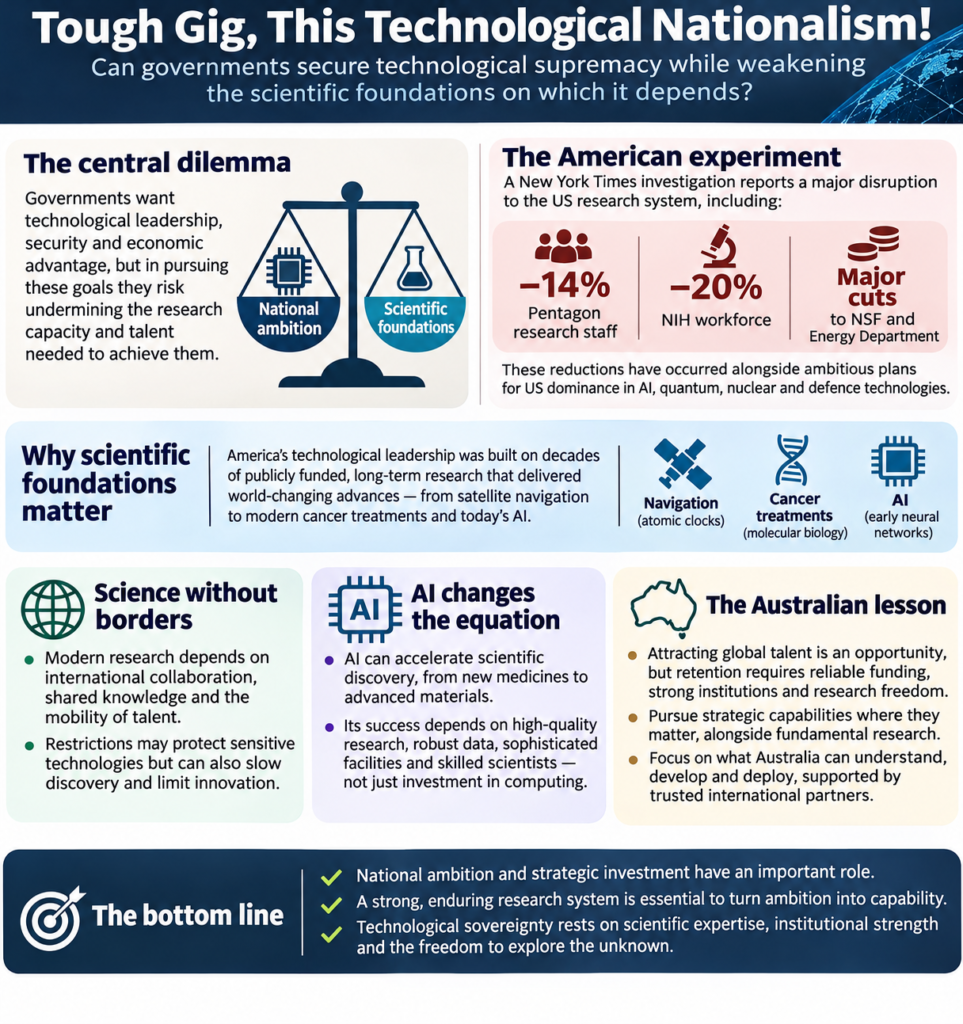
Atomic-clock research contributed to satellite navigation. Fundamental molecular biology enabled modern cancer treatments. Early publicly supported neural-network research helped lay the foundations for artificial intelligence.
These advances emerged from sustained investment, scientific independence and institutions capable of supporting research over decades.
Governments can legitimately establish national research priorities. Defence, energy, health and economic competitiveness are compelling reasons to invest public money.
But scientific discovery remains inherently uncertain. Its most valuable outcomes frequently emerge from investigations whose practical significance becomes apparent only much later.
That makes the quality and continuity of the research system at least as important as the priorities governments announce.
The American experiment
According to the New York Times investigation, the Pentagon’s research laboratories lost approximately 14 per cent of their staff during the administration’s first year.
A Defense Department assessment warned of potentially grave consequences for national defence.
The National Science Foundation suffered substantial staffing reductions and grant disruptions. The National Institutes of Health lost approximately one-fifth of its workforce. The Department of Energy, central to nuclear and advanced physical sciences research, also experienced significant personnel losses.
These changes accompanied ambitious initiatives intended to accelerate scientific discovery and strengthen American technological leadership.
Administration officials dispute claims that their policies are damaging science. They argue that restructuring will eliminate waste, restore merit-based funding and direct resources towards strategically important research.
Those are legitimate objectives. Research institutions are not immune from inefficiency, bureaucratic expansion or questionable expenditure.
The difficulty lies in distinguishing genuine reform from the erosion of scientific capability.
A laboratory’s value resides not simply in its equipment and facilities but in the accumulated expertise of its scientists, established research teams, experimental knowledge and professional relationships.
When experienced researchers depart, that institutional knowledge may disappear with them. Long-term experiments can be interrupted, collaborations disrupted and promising research programs abandoned.
Such losses are not necessarily remedied by restoring funding.
Rebuilding scientific excellence can take decades.
Science without borders
Technological nationalism also raises questions about the international character of scientific knowledge.
Governments have legitimate reasons to protect classified research, regulate sensitive technologies and secure strategically important industrial capabilities.
But modern science depends heavily on international collaboration.
A breakthrough in quantum computing may draw on mathematics developed in Europe, experimental techniques pioneered in Japan, specialised equipment manufactured in Germany and researchers trained across several continents.
Scientific publications circulate internationally, researchers move between institutions, and technologies incorporate discoveries accumulated across generations and jurisdictions.
Attempts to restrict these exchanges therefore involve trade-offs that extend beyond national security.
The international mobility of researchers makes those trade-offs particularly significant.
The New York Times reports that Australia, Canada and China are seeking to attract scientists unsettled by changes in the American research environment.
A distinguished researcher brings more than personal expertise. They may bring collaborators, graduate students, experimental techniques, research relationships and opportunities for future discovery.
The movement of a relatively small number of leading scientists can influence the development of entire research fields.
Australia should recognise the opportunity, but recruiting scientific talent is only the beginning.
Retaining it requires reliable funding, capable institutions, intellectual independence and an environment that encourages ambitious research.
AI changes the equation
Artificial intelligence adds another dimension to technological nationalism.
Governments increasingly regard AI as essential to economic competitiveness, military capability and technological sovereignty.
Yet AI-driven scientific discovery depends on vast bodies of accumulated knowledge, reliable datasets, sophisticated experimental facilities and researchers capable of interpreting and validating results.
AI can accelerate molecular discovery, materials research, complex modelling and experimental design. But its effectiveness depends on the quality of the scientific system supporting it.
Investment in computing infrastructure and AI development is therefore only part of the equation.
Without strong universities, research laboratories and a continuing supply of highly trained scientists, even sophisticated AI systems may struggle to deliver their promised scientific benefits.
AI also makes research more internationally interconnected.
Scientific models increasingly draw on knowledge produced across numerous disciplines, institutions and countries. Restricting access to that knowledge may limit the very advances governments hope to accelerate.
The strategic challenge is to protect genuinely sensitive technologies while preserving the scientific exchanges that make further innovation possible.
The Australian lesson
Australia faces its own tensions between scientific independence and national strategic priorities.
Governments want research to support sovereign industrial capability, national security and economic growth.
Universities and research institutes must maintain internationally competitive research programs, develop skilled researchers and contribute to national technological capability.
These objectives can be complementary, provided the incentives are properly aligned.
Mission-directed research has an important role, particularly in defence, energy and public health. It should complement rather than displace curiosity-driven inquiry.
Without continuing fundamental research, the pipeline of discoveries available for future technological development will eventually diminish.
Australia also needs a more precise understanding of technological sovereignty.
Complete self-sufficiency across every strategically important technology is neither realistic nor necessarily desirable for a country of Australia’s size.
A more practical objective is to develop the domestic expertise, infrastructure and industrial capacity needed to create, evaluate, adapt and deploy critical technologies, supported by reliable international partnerships.
That requires strategic choices about where Australia should develop sovereign capabilities, where collaboration offers greater value, and where dependence on overseas suppliers creates unacceptable risks.
It also requires sustained investment in research institutions and scientific talent, rather than relying on short-term initiatives tied to changing political priorities.
A nation’s technological strength is ultimately determined by what it can understand, develop and deploy, not simply by what it declares strategically important.
The science must come first
The American experience raises a broader question about the relationship between political ambition and scientific capability.
National research strategies can identify priorities, concentrate resources and encourage innovation. But their success depends on the institutions and people responsible for carrying them out.
The United States became a scientific superpower partly because it recognised that fundamental research was a long-term public investment whose benefits could not always be predicted.
Whether its current approach will strengthen or diminish that inheritance remains to be seen.
For Australia, the lesson extends beyond the immediate opportunity to attract international researchers.
Scientific institutions must be sustainable, research priorities must reflect legitimate national interests, and public investment must deliver benefits to the community.
But those objectives require a scientific system capable of generating new knowledge over successive generations.
Technological sovereignty is not achieved through declarations of national ambition alone. It must be supported by scientific expertise, institutional strength and the freedom to investigate questions whose answers are not yet known.
You can control the funding. You can dictate the national priorities. You can protect strategic technologies.
But you cannot command the next great discovery.
Tough gig, this technological nationalism.
And potentially a very expensive one.