
The AI Productivity Paradox: Saving Time Isn’t the Same as Making Money
Businesses are investing heavily in artificial intelligence on the assumption that greater productivity will translate into stronger financial performance. But an uncomfortable question is emerging: if AI is saving businesses so much time, why aren’t the financial benefits more apparent?
The problem is that businesses are confusing efficiency with economic value. Completing work faster does not necessarily reduce costs, increase revenue or improve profitability. Unless the time released is put to productive use, AI may simply allow businesses to do the same work in fewer hours without materially improving their bottom line.
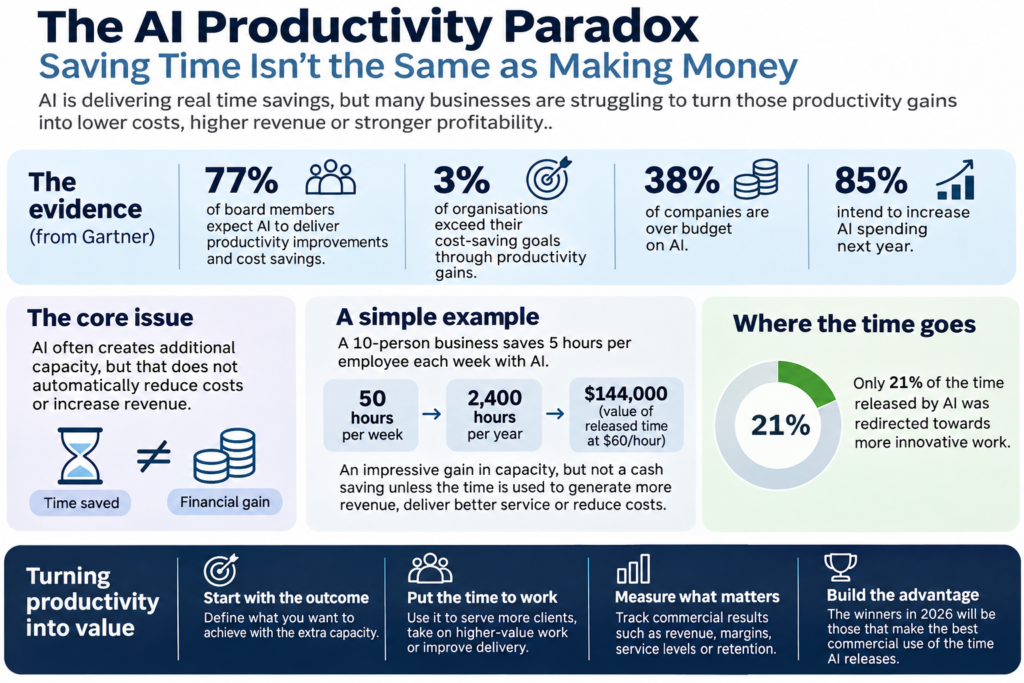
New research from Gartner exposes the scale of this challenge. According to findings released on 26 October, 77 per cent of board members expect AI to deliver productivity improvements and cost savings, yet only 3 per cent of organisations exceed their cost-saving goals through productivity improvements. This does not mean the remaining organisations achieve no benefits, but it reveals a gap between expectations and financial outcomes.
Gartner also reports that 38 per cent of companies are over budget on AI, while 85 per cent intend to increase their spending next year. Businesses are committing more resources to technology whose economic returns remain difficult to capture.
This is the AI productivity paradox.
The difference between capacity and value
Consider a professional-services business employing ten people that introduces AI tools to accelerate research, document preparation, reporting and administration. If each employee saves five hours a week, the business gains 50 hours of additional weekly capacity.
Across 48 working weeks, that represents 2,400 hours annually. At an illustrative labour cost of $60 an hour, the released working time has a theoretical value of $144,000.
On paper, this looks like an impressive return, but whether the business has actually saved $144,000 is another matter.
If employees continue working the same hours, receive the same salaries and produce approximately the same commercial results, payroll expenses remain unchanged. The business has created capacity rather than reduced costs.
That capacity could be extremely valuable if employees use it to serve more customers, complete additional assignments, improve service quality or develop new products. If the released time is absorbed by additional meetings, less demanding working days or more elaborate versions of existing tasks, the financial benefit may be considerably smaller.
AI therefore creates the opportunity for improved productivity, but management decisions determine whether that opportunity translates into economic value.
Where does the saved time go?
Perhaps the most revealing finding in Gartner’s research comes from a separate survey of 1,865 employees, which found that only 21 per cent of the time released by AI was redirected towards more innovative work.
This raises an important question for business leaders about what actually happens when technology removes routine tasks.
There is nothing inherently wrong with reducing workloads or improving working conditions. Lower stress, fewer errors and greater job satisfaction are legitimate benefits, particularly in businesses struggling to attract and retain employees. However, these improvements should not automatically be counted as financial savings.
A business investing in AI to improve profitability needs to establish how the additional capacity will contribute to commercial performance. Otherwise, it risks confusing improvements in individual activities with improvements in the performance of the business as a whole.
Producing a report in ten minutes rather than an hour demonstrates greater efficiency. Using the time saved to complete another assignment, respond more quickly to customers or develop a new service demonstrates how that efficiency can create value.
The opportunity for small business
For Australian small and medium-sized enterprises, this distinction is particularly important because investment resources are limited and every expenditure competes with other business priorities.
The temptation is to evaluate AI tools according to the hours they promise to save. A more useful starting point is to consider what the business could accomplish with additional capacity without proportionately increasing its workforce.
An accounting practice, for example, might use AI to reduce the time required for routine reporting, reconciliations and financial analysis. While faster processing is beneficial, the greater opportunity may be to redirect employees towards advisory services, support additional clients or provide more frequent financial insights.
Similarly, a consulting firm could use AI simply to produce reports faster, or it could use the additional capacity to undertake more complex assignments and develop services that were previously uneconomic.
For manufacturers, AI-supported scheduling, analysis and quality control could reduce administrative demands while helping identify production problems earlier. The resulting improvements might support shorter delivery times, fewer defects and greater reliability, strengthening competitiveness without necessarily reducing employment costs.
These examples illustrate why the economic value of AI depends as much on the business model and management decisions as on the technology itself.
The next competitive advantage
In an earlier column, AI May Make the Small Business Bigger, I argued that artificial intelligence could give smaller firms access to capabilities previously available mainly to larger organisations.
AI can enable small businesses to undertake sophisticated analysis, produce professional material, automate routine processes and manage more complex operations without a corresponding increase in employee numbers.
That opportunity remains compelling, but Gartner’s findings highlight an important qualification. Greater capability does not automatically produce business growth. The additional capacity must be deliberately directed towards activities that improve performance.
This suggests two approaches to AI adoption. The first concentrates on efficiency, asking how existing work can be completed faster and with less effort. The second focuses on opportunity, asking what additional services, stronger customer relationships or competitive advantages become possible because existing work can now be completed more efficiently.
Both approaches have merit, although the second may ultimately prove more important for businesses seeking sustainable growth.
As AI tools become more widely available, simply adopting the technology is unlikely to provide a lasting competitive advantage. Competitors can purchase similar software, but they cannot automatically replicate how a business combines technology with industry knowledge, employee expertise, customer relationships and commercial strategy.
The competitive advantage increasingly lies in how effectively these resources are brought together.
Measuring what matters
This requires businesses to reconsider how they evaluate AI investments. Counting hours saved is relatively straightforward, whereas measuring the economic value created by those hours requires greater discipline.
Rather than focusing exclusively on time savings, businesses should identify the commercial outcomes they want to improve. Depending on the industry, these might include revenue per employee, customer retention, operating margins, assignments completed, delivery times or the cost of correcting errors.
There is also a practical management question about who is responsible for putting the released capacity to work.
An organisation that saves ten hours a week in administration might allocate that time to customer follow-up. A professional practice could redirect capacity towards developing advisory services, while a retailer might use faster inventory analysis to improve stock availability and reduce lost sales.
In each case, the technology investment is connected to a defined business objective rather than an abstract promise of greater efficiency.
Not every benefit needs to appear immediately as additional revenue. Better accuracy, improved customer service, reduced risk and stronger employee retention can create considerable value over time. What matters is establishing a credible connection between the productivity improvement and the intended business outcome.
Competing in 2026
Businesses have experienced similar challenges during previous waves of digital transformation. New systems make processes faster and information more accessible, yet the anticipated improvement in profitability does not always follow because technology changes individual tasks without necessarily changing the performance of the entire organisation.
AI makes this problem particularly visible because its immediate productivity gains can be substantial. However, faster task completion may have limited financial impact if customer demand remains unchanged, sales processes are ineffective or operational bottlenecks simply move elsewhere.
Gartner’s evidence comes primarily from larger organisations, so its percentages should not be applied directly to Australian SMEs. Nevertheless, the underlying management lesson is relevant to businesses of almost every size.
For Australian businesses competing in 2026, the question is no longer simply whether AI can improve productivity, but whether those improvements can be translated into stronger economic performance.
Some businesses will use AI primarily to control costs, while others will use it to expand their customer base, improve service or develop capabilities that were previously too expensive. The strongest performers may achieve a combination of these outcomes.
The businesses that benefit most will not necessarily be those adopting the greatest number of AI tools or automating the most tasks. They will be those that make the best commercial use of the capacity AI releases.
Saving time creates an opportunity. Turning that opportunity into economic value is what will determine the winners in 2026.
Source: Gartner, 26 October 2026, Gartner HR Research on AI Productivity and Cost Savings.