
AI Is Evolving Fast. Human Intelligence Took Millions of Years.
What the evolution of language and human understanding reveals about the different strengths of artificial intelligence and human judgment in business.
Evolution’s Head Start
Artificial intelligence has developed remarkable capabilities in a relatively short time. Large language models can analyse complex information, write software and solve problems that once required considerable human expertise.
Yet these achievements raise an interesting question: how much of intelligence involves processing information, and how much depends on the experience of living and interacting with the world?
Human intelligence has been shaped over millions of years by the need to survive, cooperate and adapt. AI has followed a very different path, acquiring much of its capability by identifying patterns and relationships in enormous quantities of information.
Recent research into the evolution of writing and how the brain constructs meaning offers some useful insights into these differences.
The Long Road to Writing
Cognitive scientist Olivier Morin, of the Institut Jean Nicod in Paris, has explored why writing capable of expressing complete thoughts appeared so late in human history.
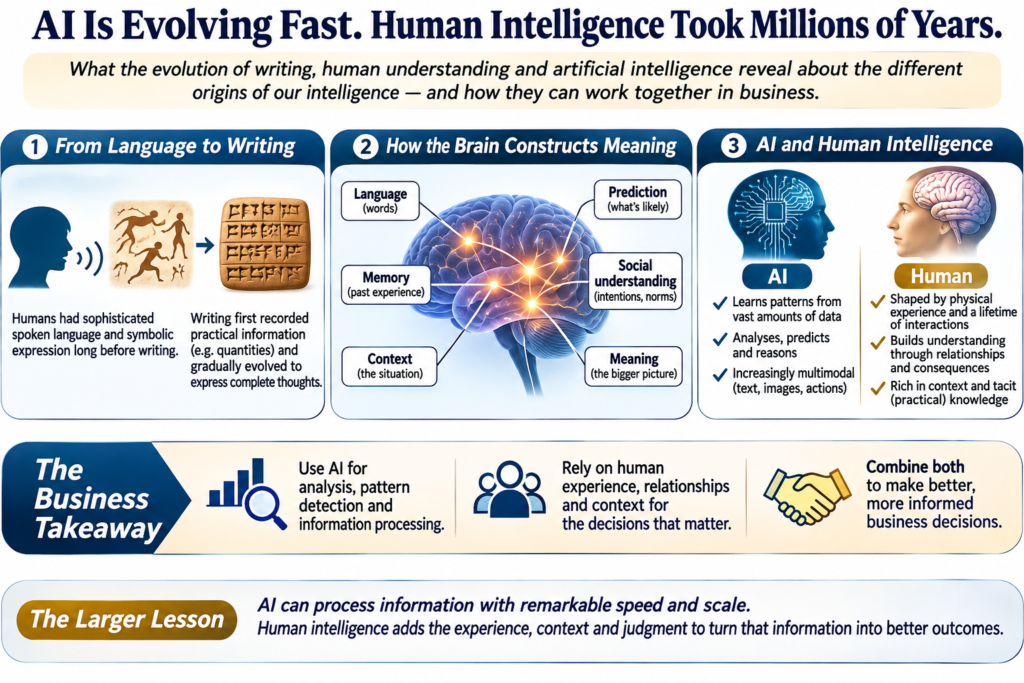
Humans possessed sophisticated spoken language long before writing emerged around 5,000 years ago. Early writing developed largely from practical activities such as accounting and administration, gradually becoming capable of communicating complete thoughts independently of their original circumstances.
The distinction is important. Recording information is relatively straightforward; communicating meaning to someone who does not share the original context is considerably more difficult.
Morin’s research reminds us that possessing sophisticated intelligence and developing technologies capable of expressing it are different achievements.
How the Brain Constructs Meaning
Human understanding involves much more than decoding words. When someone remarks, “It’s getting cold in here,” we may recognise an indirect request to close a window rather than simply an observation about temperature.
The words provide only part of the message. Our interpretation draws on memory, expectations, social conventions and assumptions about the speaker’s intentions.
Much of this understanding develops through experience and becomes so familiar that we rarely recognise how much information we are supplying ourselves.
What AI Has Learned From Language
Modern language models offer an intriguing comparison. By learning patterns in language, AI systems acquire representations of relationships involving objects, people, events and the wider world.
Neuroscience research has found that some computational language models can predict aspects of human brain activity during language comprehension, suggesting that prediction plays an important role in both systems.
However, similarities in performance do not necessarily imply identical forms of understanding.
Humans learn through physical experience, social interaction and the consequences of their actions. AI can explain and reason about many of these experiences without necessarily acquiring its knowledge in the same way.
As multimodal AI and robotics develop, these differences may narrow in some areas, although important questions about the nature of understanding remain unresolved.
The Nuances of Business Reality
The distinction becomes particularly relevant when businesses rely on AI to support decisions rather than simply process information.
Consider a long-standing customer whose orders have declined. AI might identify the trend, analyse purchasing patterns and recommend a promotional offer. An experienced account manager may know that a generational transition, a new purchasing manager or an unresolved service issue is responsible.
The analysis may be accurate, but the recommendation could miss the underlying problem.
Equally, human intuition can be mistaken. AI may identify overlooked patterns or challenge assumptions that have become embedded in the business.
The value comes from combining analytical capability with the contextual understanding needed to make effective decisions.
The Competitive Advantage
Much of the knowledge accumulated within an established business is never formally documented. It resides in employees’ experience, customer relationships, operational understanding and familiarity with the market.
As AI becomes more widely available, these assets may become increasingly important sources of differentiation. Competitors can acquire similar technology, but they cannot as easily replicate years of accumulated experience and trusted relationships.
AI offers opportunities to make that knowledge more accessible and productive, particularly when it reduces the time employees spend processing information and allows them to concentrate on customers and complex decisions.
The Larger Lesson
The evolution of writing, research into human comprehension and the development of AI all suggest that intelligence involves more than the ability to process information.
Human understanding is shaped by experience, context and interaction with the world. AI demonstrates that sophisticated capabilities can also emerge through learning patterns in language and other data.
For business owners, the practical question is not which form of intelligence is superior, but how their different strengths can be combined.
The opportunity is to use AI’s analytical capabilities to extend human intelligence, rather than assume that faster information processing automatically produces better judgment.