
Don’t Confuse the Speed of AI With the Speed of Business
AI may be advancing at unprecedented speed, but history teaches that turning technological breakthroughs into lasting business value takes considerably longer.
TECHNOLOGY MOVES FASTER THAN BUSINESS
The debate about artificial intelligence is increasingly focused on the speed of technological development. Silicon Valley executives are predicting rapid advances in AI capabilities, with some suggesting that the pace of change will be unlike anything we have experienced before.
They may be right about the technology, but that does not mean businesses will change at anything like the same speed.
WE’VE BEEN HERE BEFORE
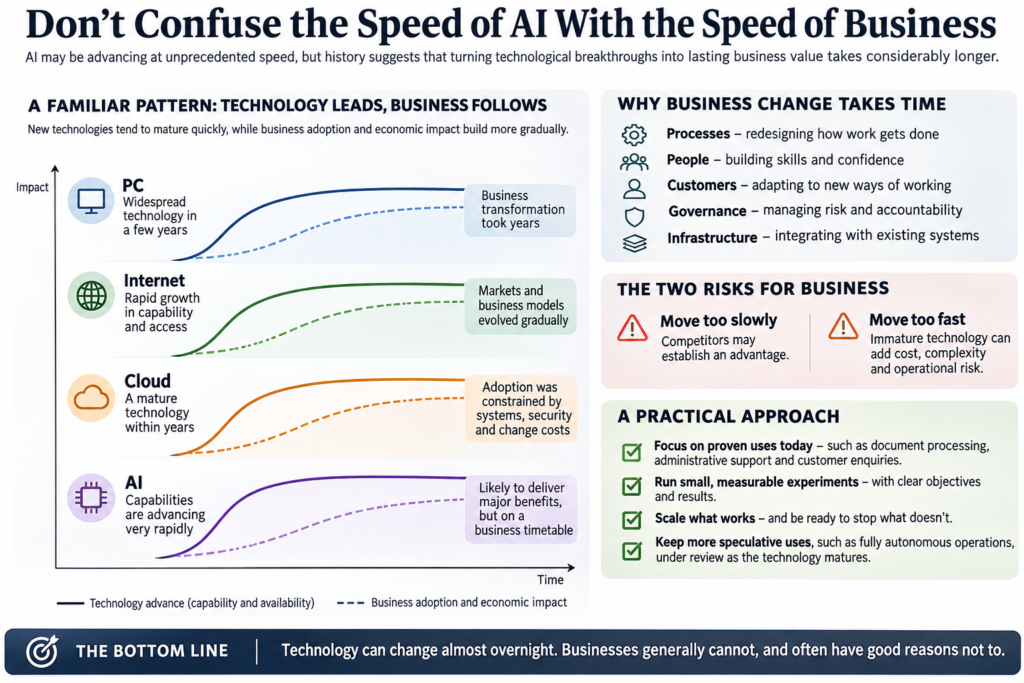
The arrival of the personal computer, the internet and cloud computing each prompted predictions of rapid and fundamental changes to business. All three eventually delivered substantial benefits, but their adoption and economic impact took considerably longer than many early forecasts suggested.
In each case, the technology advanced more quickly than the organisations expected to use it. Artificial intelligence is likely to follow a similar pattern, even if its capabilities develop more rapidly than those of earlier technologies.
THE REAL CONSTRAINT IS BUSINESS CHANGE
Business productivity depends on more than access to better technology. It requires changes in how organisations operate, how employees work and how customers interact with them.
An AI application might substantially reduce the time required to complete a task, but converting that saving into improved profitability is a management challenge rather than a technological one.
This distinction matters particularly for smaller businesses, where resources are limited and maintaining day-to-day operations remains the immediate priority.
ADOPTION REQUIRES COMMERCIAL JUDGEMENT
Businesses face a genuine dilemma. Delaying investment may allow competitors to establish an advantage, while moving too aggressively can introduce costs and risks without delivering corresponding benefits.
The sensible response is to experiment with applications that offer measurable value rather than commit substantial resources to predictions about what AI might eventually achieve.
Importantly, customers do not necessarily change their behaviour simply because new technology becomes available, nor do businesses abandon established practices that continue to work. The economics of adoption ultimately matter more than the pace of innovation.
VALUE MATTERS MORE THAN SPEED
None of this diminishes AI’s potential. The personal computer, internet and cloud computing all transformed business, but their effects accumulated over time and varied considerably between industries.
AI may ultimately have an even greater impact, although there is little reason to assume that its commercial adoption will match the speed of its technical development.
For business owners, the priority should be to develop the capacity to identify and adopt useful innovations as they become commercially viable, rather than attempt to keep pace with every technological breakthrough.
Technology can change almost overnight. Businesses generally cannot, and often have good reasons not to.