
AI-Proofing Your Business
How AI is changing the economics of competition—and what SMEs can do to protect their competitive position.
Most established small and medium-sized businesses have, over time, developed advantages that help protect them from competition. Business consultants sometimes refer to these as a moat: the combination of capabilities and attributes that gives customers a reason to choose one business over another.
These advantages may be based on location, specialist expertise, reputation, customer relationships, established processes or simply the ability to deliver more reliably than competitors. Some are deliberately developed, while others emerge through years of experience and investment.
For many SMEs, these strengths are not formally recognised. They are embedded in how the business operates, what its people know and why customers keep coming back.
Artificial intelligence is beginning to change their competitive value.
Capabilities that once required substantial capital, specialist employees or organisational scale are becoming accessible to much smaller businesses. This creates opportunities to improve productivity and compete more effectively, but also makes some established advantages easier for competitors to replicate.
AI-proofing a business does not mean protecting it from technological change. It means understanding how AI is changing competition and adapting the business to remain competitive.
When Intelligence Becomes Widely Available
For decades, larger businesses could afford specialist capabilities and sophisticated systems that smaller competitors struggled to match. AI is narrowing some of these differences by making research, analysis, programming, marketing and automation more accessible.
Scale still matters, particularly in capital, purchasing power and distribution. However, the resources needed to compete effectively in many activities are falling.
As AI adoption spreads, access to sophisticated intelligence is likely to become a standard business capability rather than a significant point of difference. Early adopters may enjoy an initial advantage, but as competitors catch up, many productivity improvements will become necessary simply to remain competitive.
The strategic question therefore shifts from What can AI do for our business? to What do we possess that makes AI more valuable for us than for our competitors?
What AI May Make More Valuable
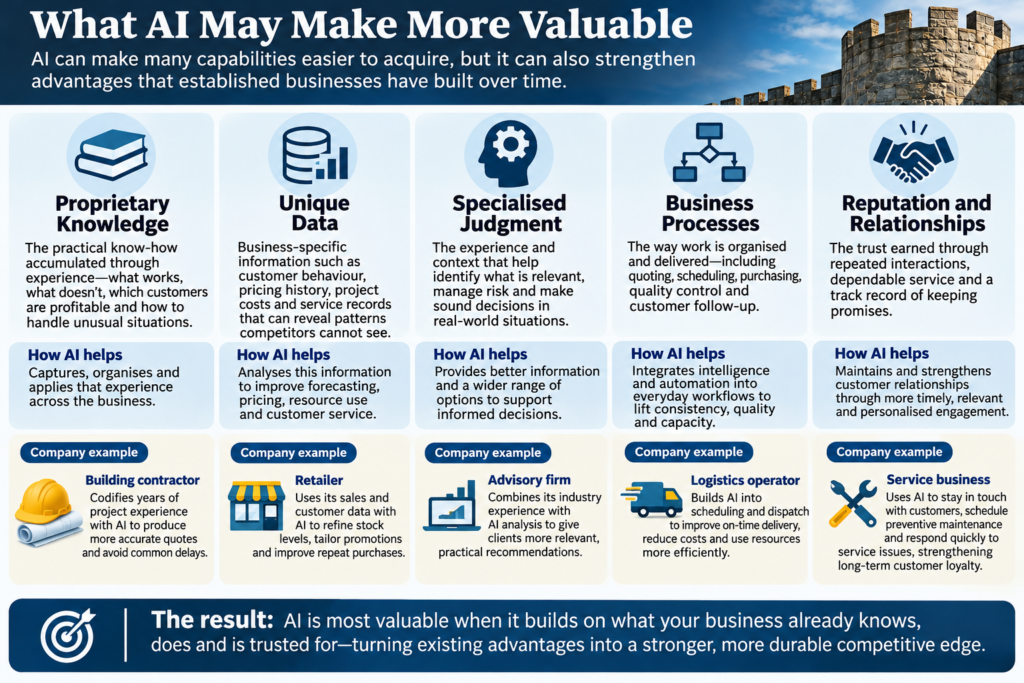
While AI makes many capabilities easier to acquire, it can also increase the value of assets that established businesses have accumulated over years of operation.
The following infographic illustrates where these opportunities may lie and how different SMEs can use AI to strengthen their existing advantages.
Productivity Is Only Part of the Answer
Improving productivity is one of the strongest reasons for adopting AI. Businesses that reduce costs, increase capacity and respond more effectively to customers can strengthen their competitive position.
However, efficiency gains may not provide lasting protection against competition. If similar improvements become widely available, their benefits may eventually be reflected in lower prices, faster delivery or higher customer expectations.
A more resilient business combines high productivity, distinctive knowledge and dependable delivery.
Productivity improves costs and capacity. Knowledge and experience support better decisions and more relevant solutions. Dependable delivery converts these capabilities into customer confidence and repeat business.
Competitors may acquire the same technology, but reproducing the combination of experience, operating practices and established trust is considerably more difficult.
How to AI-Proof Your Business
For SME owners, the practical task is to assess how AI could affect their competitive position before changes in the market make a response unavoidable.
Three questions provide a starting point:
- What is becoming easier to copy? Which products, services or capabilities could competitors reproduce more cheaply or quickly using AI?
- What could become more valuable? Which existing strengths could AI help the business use more effectively?
- What needs to change? Where should the business improve its technology, employee capabilities or operating processes to remain competitive?
These questions can help owners distinguish between investments that deliver immediate efficiency gains and those that strengthen the longer-term position of the business.
The Changing Basis of Competition
AI will not eliminate the importance of capital, scale, distribution or established market positions, nor will it automatically favour smaller businesses over larger competitors.
It does, however, change the economics of competition by making capabilities that once required substantial investment more widely accessible.
For SMEs, the opportunity is to combine these capabilities with advantages they have already developed, rather than treating AI adoption as an end in itself.
The most competitive small business may not be the one with the most automation. It may be the one that combines high productivity, distinctive knowledge and dependable delivery better than its competitors.
As we move forward, AI-proofing a business may depend less on keeping pace with the latest technology and more on using it to strengthen what the business already does well—and what competitors find difficult to copy.