
A New Meaning to “Too Big to Fail”
How circular financing within the AI industry could turn commercial success into systemic financial risk.
During the 2008 global financial crisis, the expression “too big to fail” became synonymous with financial institutions whose collapse threatened the stability of the broader economy.
Today, the artificial intelligence industry is giving the expression a new meaning. The concern extends beyond financial institutions to technology companies and potentially even to individual corporate executives whose fortunes have become intertwined with financial markets, economic growth and national security.
Nvidia and its chief executive, Jensen Huang, illustrate this emerging vulnerability. The company’s dominance in advanced AI chips, enormous market capitalisation and financial relationships raise an uncomfortable question: can a company become so economically important that the consequences of holding it, or its leadership, accountable threaten financial market stability?
THE CIRCULAR FINANCING MODEL
Nvidia is evolving from a semiconductor manufacturer into a significant provider of financial support to the AI industry.
Through investments, financial guarantees and computing capacity commitments, Nvidia helps finance the market for its own products. The accompanying infographic illustrates the scale and mechanics of these arrangements.
Supplier financing is a legitimate commercial practice, particularly in capital-intensive emerging industries. However, its scale raises a fundamental economic question: how much demand would exist without the financial support provided by the suppliers themselves?
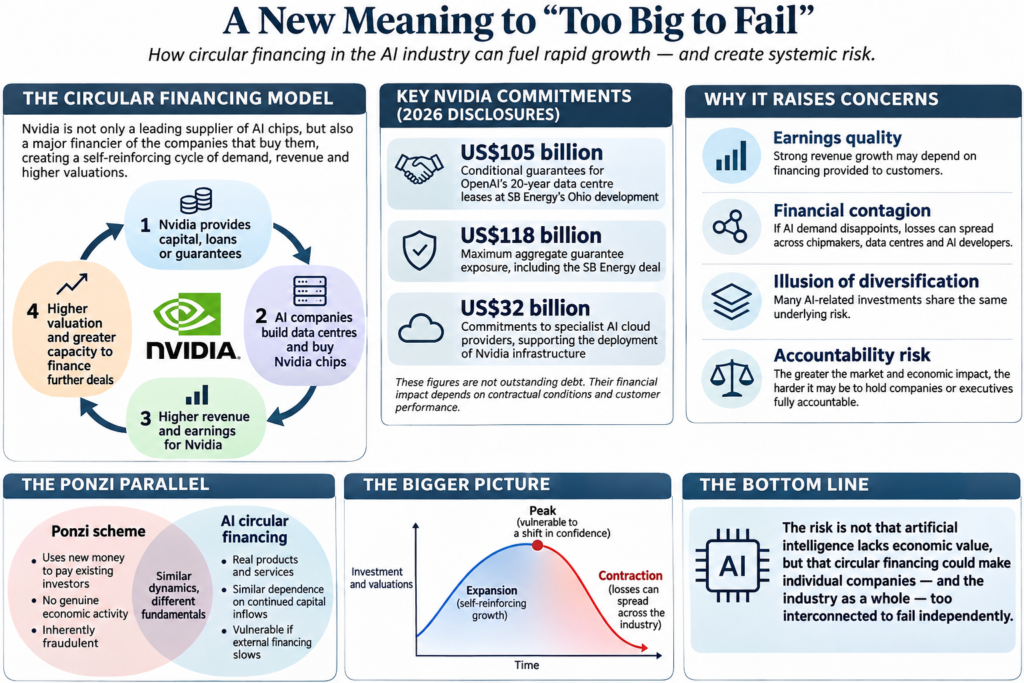
THE PONZI PARALLEL
Although circular financing should not be confused with a Ponzi scheme, it can exhibit a similar dependence on continued capital inflows.
A more appropriate economic explanation is George Soros’s concept of reflexivity. Rising valuations improve access to capital, which finances expansion, strengthens reported financial performance and supports further increases in valuations.
The danger is that reflexivity works in both directions. When investor confidence deteriorates, the virtuous cycle can become a vicious cycle.
LESSONS FROM HISTORY
During the telecommunications boom of the late 1990s, equipment manufacturers such as Lucent and Nortel provided financing to customers purchasing their equipment. When anticipated demand failed to materialise, manufacturers faced deteriorating sales and customer creditworthiness simultaneously.
Economist Hyman Minsky anticipated this broader phenomenon in his Financial Instability Hypothesis: prolonged periods of economic success encourage increasingly risky financing arrangements, eventually creating the conditions for financial instability.
In effect, stability breeds instability.
THE IMPLICATIONS FOR INVESTORS
Traditional financial analysis becomes more complicated when suppliers help finance their customers. Reported revenue may be entirely legitimate under accounting standards, yet its sustainability may depend on continued access to capital rather than independent commercial demand.
Investors need to look beyond earnings growth and examine free cash flow, receivables, contingent liabilities and returns on invested capital.
Equally important is recognising that diversification across companies is not necessarily diversification across economic risks.
THE COST OF ACCOUNTABILITY
When the difficulties of a single company or the departure of its chief executive threaten substantial losses across financial markets, governments and regulators may face a conflict between enforcing corporate accountability and maintaining financial stability.
This introduces the familiar problem of moral hazard that characterised the global financial crisis. Commercial success can ultimately become a source of institutional vulnerability.
THE ULTIMATE TEST
None of this diminishes the transformative potential of artificial intelligence. History, however, demonstrates that technological breakthroughs and investment bubbles are not mutually exclusive.
The internet transformed the global economy, yet many of the businesses financing its early development failed to generate sustainable investment returns.
Ultimately, the sustainability of the AI investment boom will depend not on how much capital circulates within the industry, but on how much independent commercial revenue and economic value it generates for its end customers.
The new meaning of “too big to fail” is that individual companies may become too important to discipline, while an entire industry becomes too interconnected to fail independently.